• Welcome to the BMW Scooter Forums. Member registration disables ads and allows you to post and share. Register Here.

C650 sport performance test

The stock variator is different on the C600 compared to the C650, and the transmission gear ratios are different as well. Malossi variators also have different part numbers and are not interchangeable.

The graph also shows the results with a sports exhaust manifold and a sports muffler. However, it seems that the key is to target the right torque range, which this scooter already delivers at around 6,000–6,500 rpm.

These results are based on Dragy app testing, with quite a large number of repeated runs.
 
My findings prove the opposite, so I will tune with 20 gr.
My question is, if anyone knows whether increasing the rev limiter is safe or not.
 
Hello,
No, it’s not risk-free. Even though this engine is a square-stroke design and therefore delivers its best performance at high RPM (as you’ve noticed), limiting the maximum RPM remains a very important safety factor.

Why is this risky?
Increasing the maximum RPM cannot be considered in isolation. It must be accompanied by mechanical modifications, particularly to the valve train, valve springs, and camshafts and, more generally, by reducing the moving masses in the engine. Without these changes, there is a very real risk of premature wear and of valve panic (since the stock springs will no longer be able to keep up).
It’s also important to consider that certain components are designed by the manufacturer based on the maximum RPM, or that the maximum RPM is set based on cost savings achieved by compromising the quality of certain parts (stator, regulator, water pump, balance shaft, crankshaft bearings, etc.).
Finally, there are many factors that must also be adjusted when drastically increasing an engine's RPM: the oil grade, the cooling system's capacity, the air intake, etc.

Your fuel injection curves, on the other hand, can be modified quite significantly without risk because you’re using a de-catalyzed system. You can achieve a significant improvement because the manufacturer’s settings are rather lean mixture adjustment in meeting legal requirements for emissions and noise levels, keeping fuel consumption in check, and protecting the catalytic converter (which cannot handle a rich mixture).
In your case, with a fully de-catalysed exhaust system, you can enrich the mixture without restriction and aim for the stoichiometric ratio.
 
Last edited:
Hi all,

I have just collected my scooter back from the tuner.
I decided to tune with 22gr rollers and stock contra spring, so rpm would drop at wot and the tuner could have a better view of a wider rpm range.

Gains were as expected, medium at medium rpm and high at high rpm.:p

From 60 till 145 km/h rpm are 6900-7000 according to obd data. At 160 km/h, rpm are 7500 (where gains get higher) and at 170-175, rpm are 7800-8000 (where gains are huge).
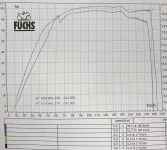
We also increased the rev limiter to 8800 and as you can see from the graph, hp is still strong, even rising.

My tuner also succeeded in being able to fully deactivate the traction control, which is very very important to me, as it was very annoying, even dangerous on bumpy road.

Overall I am very satisfied, I will test the performance on the road using my pbox and will post the results to compare.

For those who will argue that hp drops after 145 km/h, dyno losses increase disproportionally as speed rises.
 

Attachments

  • b34e2baf-b26e-4827-ab2a-99a4fc55a240.webp
    b34e2baf-b26e-4827-ab2a-99a4fc55a240.webp
    98.7 KB · Views: 2
Last edited:
Back
Top